Listen to this post

Heirs property generally refers to family-owned property inherited by multiple generations without formal legal proceedings, resulting in a lack of clear title proving ownership. As explained in a 2018 Florida Bar Journal article entitled The Disproportionate Impact of Heirs Property in Florida’s Low-Income Communities of Color, these arrangements can lead to all sorts of negative consequences for family wealth creation. In response, in 2020 Florida adopted the Uniform Partition of Heirs Property Act (F.S. Ch. 64, Part II), which was hailed by housing advocates as an important and necessary step in closing the “racial wealth gap.”

Following that legislative reform the challenges faced by families with heirs property continues to garner much needed attention, including from national corporate actors like Wells Fargo. As recently reported by the Miami Herald in Heirs to Black-owned homes face ramped-up foreclosures. Here’s who’s pushing back:

In April, Legal Services of Greater Miami received a $600,000 grant from the Wells Fargo Foundation, which will partly be used to brief Miami-Dade residents about the issue and provide free legal assistance to heirs’ property owners in untangling titles, building on the organization’s work so far in Liberty City funded by Bank United.

Legal Services has fielded approximately 30 requests for help with potential heirs’ property matters.

“At a time like now, where affordable housing is becoming scarcer and scarcer, keeping a family home that you’ve had for decades is perhaps one of the most affordable ways to stay housed,” said the organization’s advocacy director, Lisa Lauck.

What’s the fix? Think Lady Bird Deeds

One of the primary causes of heirs property is a lack of basic estate planning. So not surprisingly, there’s a big push to get more property owners to engage in that kind of planning. For example, under the USDA’s loan program designed especially for heirs property you can’t qualify for one of these farm loans unless you first complete a “succession plan”.

The most commonly suggested solution for this lack of planning is a will. That may work if you’re focusing on farms and ranches but it’s clearly not the best option for the vast majority of Floridians, whose most common form of heirs property is going to be a single family home. All of the heirs-property examples reported on in the Miami Herald article involved single family homes. Most (probably all) of these families would be better served by “Lady Bird Deeds”.

Lady Bird Deeds (also referred to as “enhanced life estate deeds”) are ideally suited for the single most valuable asset most people own when they die: their home. Why? Because these deeds offer a simple, inexpensive way to transfer real estate at death without the costs and delays of probate (vs. a will, which has no legal effect unless it’s probated). And in another contrast to wills, Lady Bird Deeds should be publicly recorded as soon as they’re signed (there’s no mechanism in Florida for publicly recording wills prior to the testator’s death). So there’s no risk of the deed getting lost or misappropriated years later. (A lost will is an invitation for litigation.)

If you’re a practitioner and want to dive into the weeds on the technicalities of these deeds, a good starting place is Lady Bird Deed: An Inexpensive Probate Avoidance Technique. And if you’re looking for a plain English summary of why these deeds are so popular as well as a chart showing the differences between lady bird deeds (a/k/a enhanced life estate deeds) and traditional life estate deeds, look no further than Giving the Bird. Lady-Bird Deeds:

And last but not least, thank you to Orlando real estate attorney Norman W. Nash, who reminded me of another great resource for practitioners preparing (or even just considering) lady bird deeds. It’s the Florida Uniform Title Standards published by the Real Property, Probate, and Trust Law Section of the Florida Bar. The following three title standards address lady bird deeds (a/k/a enhanced life estate deeds) directly:

For more on the backstory to these title standards you’ll want to read Enhanced Life Estates Are Now Standard Practice. Here’s an excerpt:

The issue, as noted in the comments to all of the uniform title standards to be discussed in this article, is, “although Lady Bird Deeds are used prevalently in Florida for various purposes, there is no Florida Statute governing such conveyances and scant judicial authority supporting the practice.” Recognizing the lack of authority available, last year the Uniform Title Standards Committee of the Real Property, Probate and Trust Law Section of The Florida Bar approved three new title standards regarding enhanced life estates to “represent the consensus view of the Real Property, Probate, and Trust Law Section of The Florida Bar.” Each uniform title standard contains the title standard, examples of hypothetical fact patterns illustrating the application of the title standard, and commentary about the title standard.

Rohan Kelley doesn’t use Lady Bird Deeds

Rohan Kelley is Florida’s leading thought leader on all things homestead and author of the famous Kelley’s Homestead Paradigm. So when Rohan says he’s not a fan of Lady Bird Deeds, we all need to stop and listen. With Rohan’s permission I’ve quoted below an email he was kind enough to send me in response to this blog post. Here’s the bottom line for Rohan:

The clear intent of an enhanced life estate deed is as a will substitute.  At least to the extent the property is protected homestead, it simply doesn’t work even though the use of this will substitute nearly always involves homestead.

Rohan’s point is well taken … as far as it goes. If the subject property is your personal residence it’s also going to be “homestead” property that’s subject to the restrictions on devise contained in Article X, §4(c) of Florida’s constitution. And if you’re survived by a spouse or minor child and you invalidly devise your homestead property — be it by Will or Lady Bird Deed — that devise is going to fail. For an example of a failed devise of homestead property via a Lady Bird Deed, see Problem 2 of Florida Bar Title Standard 6.12.

On the other hand, if you’re not survived by a spouse or minor child or if you otherwise validly devise your homestead property — be it by Will or Lady Bird Deed — that devise is going to work. For multiple examples of successful devises of homestead property via a Lady Bird Deed, see Problems 1, 3 and 4 of Florida Bar Title Standard 6.12.

And that’s my point. If a devise of homestead property is subject to the same restrictions be it by Will or Lady Bird Deed, why not default in favor of the self-executing probate-avoidance benefits of a Lady Bird Deed? For example, in both family stories reported on in the Miami Herald article a devise of the subject homestead property via a Lady Bird Deed would have worked without the costs and delays of probate (vs. a will, which has no legal effect unless it’s probated).

But I’ve been doing this lawyering thing long enough to fully concede I could be wrong. Here’s the full text of Rohan’s thoughtful and scholarly comment (which I highly recommend):

I don’t use lady bird deeds because I’m concerned that they might be subject to challenge in some circumstances, especially if enough money were involved.  There is only one case in Florida that discussed what has become known as an enhanced life estate deed, Oglesby v. Lee, 73 Fla. 39, 73 So. 840 (Fla 1917).

The “remainder” interest created is an unvested interest, not as argued by some that it is a vested remainder subject to divestment.

In Oglesby, in dictum, the court stated “That such conveyance was in effect a will . . . .” (At page 41.)  The other fact in Oglesby that makes it inapplicable to the modern use of a lady bird deed is the fact that “[Grantor, who was also the remainderman’s father] was appointed guardian of [remainderman], then a minor, ‘to protect and preserve the consideration received from J. W. Oglesby for the land.’” Another relevant fact that distinguishes Oglesby is “. . . said land is wild, unimproved, and unoccupied except such occupancy as that of cutting timber therefrom.”  Hence it was not protected homestead.

This case has never been cited by any other Florida case.

Only one other Florida case involved an enhanced life estate.  Agee v. Brown, 73 So.3d 882 (Fla 4th DCA 2011). That case involved the issue of whether a lawyer who prepared an earlier will for a client that included himself and his wife as beneficiaries, and was alternate personal representative of the earlier will, was an interested person who could challenge the later will.   Judge Speiser held that because the lawyer was presumed to have exerted undue influence thereby rendering the will he prepared void, he had no interests under which he could contest the later will.  The 4th DCA reversed.  However, the validity or effect of the enhanced life estate was not an issue in the case.

The other consideration is Title Standard 6.12 Problem 2, that states:

STANDARD 6.12

ENHANCED LIFE ESTATE: REMAINDERMAN AND HOMESTEAD PROPERTY STANDARD: THE REMAINDERMAN IN HOMESTEAD PROPERTY, WHEREIN THE LIFE TENANT RESERVED THE POWER TO SELL, CONVEY MORTGAGE AND OTHERWISE MANAGE THE FEE SIMPLE ESTATE, ACQUIRES FEE SIMPLE TITLE UPON THE DEATH OF THE LIFE TENANT ONLY WHEN NOT IN VIOLATION OF CONSTITUTIONAL RESTRICTION ON DEVISE OF HOMESTEAD.

Problem 1: A remainder in Blackacre was conveyed by John Doe, a single man, to Jane Smith with John Doe reserving for himself without any liability for waste, full power and authority in himself to sell convey, mortgage or otherwise manage and dispose of the property in fee simple with or without consideration, without joinder of the remainderman, and full power and authority to retain any and all proceeds generated by such action. John Doe died without a spouse or a minor child. Upon the death of John Doe, is fee simple title vested in Jane Smith? Answer: Yes.

Problem 2: Same facts as in Problem 1, except that John Doe died while married to Sally Brown. Upon the death of John Doe, is fee simple title vested in Jane Smith? Answer: No.

According to the Title Standard, an enhanced life estate deed doesn’t work where the grantor is survived by a spouse of minor child.  See Art. X s. 4(c) Fla. Const.

You will recall the case In re Johnson’s Estate, 397 So.2d 970 (4th DCA 1981):

“By retention of the complete control of the property with the absolute right to revoke [the enhanced life estate deed], it is apparent that the testator intended to circumvent the constitutional restriction on testamentary disposition of the homestead while at the same time treating the property as his own during his lifetime. Any statutory basis for permitting said transaction would abrogate the constitutional protection accorded to a homestead as provided in Article X, Section 4 of the Constitution of the State of Florida, which must prevail over any statutory enactment.” (At page 971) (“enhanced life estate deed” substituted for “trust instrument”)

“That which the law forbids to be done directly cannot lawfully be done by indirection.  If an attempted conveyance of homestead real estate is in legal and practical effect and operation a will, it may not be effective when the owner of the homestead leaves a wife or child.” (At page 972)

The clear intent of an enhanced life estate deed is as a will substitute.  At least to the extent the property is protected homestead, it simply doesn’t work even though the use of this will substitute nearly always involves homestead.

In summary, what we have in widespread use by Florida lawyers is an untested device that is widely misused.  The justification for why it is used is because everybody uses it.  What if everybody is wrong?

I subsequently asked Rohan for clarification based on my thoughts above, and he kindly agreed. Rohan’s point is that there is a lack of clear legal authority for these deeds, especially as applied to homestead property. Statutory authority explicitly validating these deeds would clear up any doubt on that front, as advocated in Transfer on Death Deeds: It Is Time to Establish the Rules of the Game. In the absence of explicit statutory authority the best we have are the Florida Bar’s title standards listed above (6.10, 6.11, and 6.12), all of which confirm the validity of Lady Bird Deeds. Against this backdrop here’s the full text of Rohan’s follow up comment, which I again highly recommend:

Your point is if decedent’s homestead is not protected homestead (as defined in s. 731.201(33), why not use a lady bird deed. It would appear from the Title Standards that is an acceptable procedure.

I believe Jerry Solkoff, Esq. is generally credited with having “invented” the lady bird deed, similar to Norman Dacey having “invented” the revocable living trust.

My concern with the validity of a lady bird deed, whether or not involving unprotected homestead, is two-fold.

First, as I alluded in my earlier e-mail, only one Florida case has ever involved the procedure known as an enhanced life estate deed and the facts were significantly different from the ordinary usage of that procedure. What has evolved is literally hundreds of thousands of documents involving real estate probably worth many billions of dollars that has no basis in Florida case law or statutes.

My usual reaction to a lawyer who makes a statement regarding existing law is to ask “what is your authority” and the answer in this instance is “none.”

My second concern relates to the fact that such a deed is a “will substitute.” 736.0403(2)(b) fla.Stat. provides in part:

“The testamentary aspects of a revocable trust, executed by a settlor who is a domiciliary of this state at the time of execution, are invalid unless the trust instrument is executed by the settlor with the formalities required for the execution of a will in this state.”

If I walks like a will and quacks like a will, it must conform to the statute of wills. The formalities for execution are different for execution of a will than they are for execution of a deed. Compare 732.502 Fla.Stat with 689.01 Fla.Stat.

Hence, in my opinion, it is uncertain whether an enhanced life estate deed “works” even for non-homestead real property. You might say “Well, just execute lady bird deeds with the formalities required for the execution of a will in this state.” There seems a lot of uncertainty there as well. Can a document that professes to be and states that it is a deed, then be construed as a will, regardless of the formalities of its execution.

My view is that there are just too many uncertainties with an enhanced life estate deed to make it a viable option.

If I’m preparing a document for a client that I’m not sure is valid to accomplish its intended purpose, as a lawyer I think I have the professional responsibility to so advise the client. I am certain that NEVER happens.

I’m certain that I stand among less than 1% of lawyers on this point.

Listen to this post

F.S. 46.021 tells us that “[n]o cause of action dies with the person. All causes of action survive and may be commenced, prosecuted, and defended [against the decedent’s estate].” However, how you go about prosecuting a case — and the length of time you have to file your lawsuit — changes dramatically after someone dies.

Before someone dies you usually only have to sue them in one courtroom and worry about one set of statute-of-limitations periods. After they’ve died you’ll now have to sue them in at least two separate court proceedings and worry about two distinct sets of statute-of-limitations periods: (a) whatever limitations period applies to your civil case under F.S. Ch. 95, and (b) the second set of ultra-short limitations periods applicable in probate proceedings under F.S. 733.702 and F.S. 733.710. Litigants who forget this dual-track gauntlet for cases involving deceased defendants do so at their peril.

Florida’s layered approach for probate limitations periods, and the dangers of the “unknown unknown”

You might ask yourself why we need two different limitations periods for probate proceedings. Answer: sections 733.702 and 733.710 serve two very different functions.

733.702 is a typical statute of limitations that gets triggered after a probate proceeding is actually commenced, and under 733.702(3) it can be extended “upon grounds of fraud, estoppel, or insufficient notice of the claims period.” Key point: no probate proceeding = no application of 733.702.

733.710 establishes a maximum two year filing deadline following a decedent’s death for all unsecured claims (e.g., all tort claims), regardless of whether or not a probate proceeding’s ever commenced, and it isn’t subject to extension on any of the equitable grounds applying to 733.702. Key point: no probate proceeding = 2-year filing deadline. (In fact, one very effective defensive maneuver is to simply wait two years before opening the probate proceeding, thereby automatically barring all unsecured creditor claims).

This kind of absolute filing deadline’s referred to as a “statute of repose” or “non-claim statute”. Because 733.710 applies even if there’s no probate proceeding (and thus no notice), it’s a classic example of the kind of “unknown unknown” that keeps litigators up at night. No matter how meritorious and just your cause might be, this non-claim statute could get your case tossed out of court. And because this limitations period’s buried deep in our probate code, your average civil litigator could be forgiven for never even knowing it exists. Yup, that’s a big unknown unknown.

Are casualty insurance claims exempt from 733.702? YES

Consider this common scenario: you’re driving a delivery truck and you harm someone in an accident because of your negligence. Usually, your casualty insurance policy will step in to compensate the person injured by your negligence. In other words, this insurance money goes to the victim, not the negligent driver or the negligent driver’s estate.

If an injured victim is suing the estate of the deceased negligent driver only to trigger his casualty insurance coverage, that lawsuit shouldn’t have an impact on the estate because you’re not going after any assets of the estate (the insurance money’s going to the victim not the estate). Against this backdrop 733.702(4)(b) tells us plaintiffs aren’t subject to the statute of limitations for probate claims if you’re only suing the decedent’s estate “to establish liability that is protected by the [decedent’s] casualty insurance,” and if your claim is limited exclusively to “the limits of [the decedent’s] casualty insurance protection only.”

Florida supreme court decides split among appellate courts

The question then becomes, are these same casualty insurance claims also exempt from 733.710, our two-year non-claim statute? There are all sorts of good reasons for why the answer to that question might be yes. And our appellate courts have split on the issue, some extending the exemption for casualty-insurance claims to 733.710, others not. Florida’s supreme court has now stepped in to resolve that split, ruling that casualty insurance claims are not exempt from 733.710. If you’re a probate attorney, this is a big deal.

Case Study

Tsuji v. Fleet, — So.3d —-, 2023 WL 4246120 (Fla. June 29, 2023)

This case involved a truck driver who injured two people in a car accident while he was on the job. The driver died a few weeks after the accident for reasons unrelated to the accident. According to the supreme court, more than three years later the victims sued the driver “for negligently operating the car,” and sued his employer “for vicarious liability under the doctrines of respondeat superior and dangerous instrumentality.” When the plaintiffs found out the driver had died they substituted in the driver’s estate and “reduced their request for damages against the estate to the limits of [the decedent’s] casualty insurance coverage.”

Are casualty insurance claims exempt from 733.710? NO

Again, there are all sorts of good reasons for why we have a line of appellate authority exempting these claims from our two-year non-claim statute. On the other hand, the statute itself is clear. F.S. 733.702(5) tells us: “Nothing in [section 733.702] shall extend the limitations period set forth in s. 733.710.” And does anything in 733.710 exempt these claims? Nope, so saith the Florida supreme court:

There are only two exceptions to this statute of repose or nonclaim. Subsection (2) provides that section 733.710(1) “shall not apply to a creditor who has filed a claim pursuant to s. 733.702 within 2 years after the person’s death, and whose claim has not been paid or otherwise disposed of pursuant to s. 733.705.” § 733.710(2), Fla. Stat. And subsection (3) provides that section 733.710(1) “shall not affect the lien of any duly recorded mortgage or security interest or the lien of any person in possession of personal property or the right to foreclose and enforce the mortgage or lien.” § 733.710(3), Fla. Stat. Neither of these exceptions addresses casualty insurance.

When no exception applies, an untimely claim is “automatically barred.” Barnett Bank of Palm Beach Cnty. v. Estate of Read, 493 So. 2d 447, 448 (Fla. 1986). Section 733.710(1) is in that sense “a self-executing, absolute immunity to claims filed for the first time … more than 2 years after the death of the person whose estate is undergoing probate.” May, 771 So. 2d at 1156 (quoting Comerica, 673 So. 2d at 167).

If you’re a plaintiff and your plan is to sue an estate for one reason only — to trigger casualty insurance coverage — you’ll want to file your lawsuit before the more forgiving deadline under 733.702 is triggered. But if you blow that deadline, 733.702(4)(b) says you might get a pass under certain circumstances. But 733.710 tells us that pass only lasts for two years after the decedent’s death. Once that date rolls around you need to have filed your lawsuit (even if that means you open the probate proceeding just so you can sue the estate) or it’s game over — so saith the Florida supreme court.

Does this change really matter? Maybe not

Thank you to Naples probate attorney extraordinaire Laird Lile who pointed out to me that the court’s decision in Tsuji may not have the impact it once would have. Why? Because effective March 24, 2023, the statutory limitations period for all general negligence claims is cut in half from four years to two years under F.S. 95.11(4), which tracks the two-year statute of repose for probate claims under F.S. 733.710.

The negligence claim filed in Tsuji would have been subject to the new two-year limitations period if it had accrued after March 24, 2023, mooting the question of whether the two-year statute of repose for probate claims under F.S. 733.710 also applied. If your case is time barred under either statute, it doesn’t matter.

Here’s an excerpt from a Jimerson Birr blog post reporting on the new shorter limitations period for negligence claims:

For decades prior to the recent tort reform, the statute of limitations on negligence causes of action in Florida had been four years from when the cause of action accrued.  However, effective March 24, 2023, Fla. Stat. § 95.11, was amended to reduce the statute of limitations for negligence claims from four years down to only two years.  Fla. Stat. § 95.11(4)(a) (2023).  This generally means that a plaintiff that fails to file a lawsuit for negligence within two years of when the cause of action accrues, rather than four years, will be barred from bringing the suit under the new statute of limitations.

What Claims Does This Change Effect?

The change of the statute of limitations from four years to two years applies to general negligence claims.  General negligence claims encompass the vast majority of personal injury claims due to negligence, including by automobile accidents, slip and fall, etc., and also includes negligence claims for property damage.

However, the new shorter statute of limitations only applies to negligence claims which accrue after the effective date of the new statute, which is March 24, 2023. See H.B. 837 (“The amendments made by this act to s. 95.11, Florida Statutes, apply to causes of action accruing after the effective date of this act.”). “A cause of action accrues when the last element constituting the cause of action occurs.” Fla. Stat. § 95.031(1). A negligence cause of action generally accrues when the plaintiff is injured or suffers damages due to the act or omission of the defendant. See Dep’t of Transp. v. Soldovere, 519 So.2d 616 (Fla. 1988) (“A cause of action for the negligence of another accrues at the time the injury is first inflicted.”).

Accordingly, the new shorter two-year statute of limitations should be applicable to all general negligence claims where the plaintiff first suffered the injury or damages due to the defendant’s negligent conduct after March 24, 2023. Negligence causes of action accruing prior to March 24, 2023, should be under the prior law’s four-year statute of limitations for negligence claims.


Listen to this post

The same evidence that authorizes a probate judge to remove a personal representative nominated in your will could get her reversed on appeal for refusing to appoint this same person as personal representative at the outset. Same facts, same players, opposite legal results.

How is this possible?

Answer: there are dramatically different statutory criteria for the appointment and removal of personal representatives. Removal proceedings are governed by the broad scope of F.S. 733.504, disqualification-from-appointment proceedings are governed by the much narrower F.S. 733.303.

For example, if the nominated personal representative under your will has “conflicting or adverse interests against the estate that will or may interfere with the administration of the estate as a whole,” a probate judge is statutorily authorized to remove that person from office under F.S. 733.504(9). Unfortunately, as the 1st DCA told us over a decade ago in Werner and reminds us again in its recent Araguel opinion discussed below, this same conflict of interest doesn’t disqualify a nominated personal representative from getting appointed in the first place under F.S. 733.303. Same facts, same players, opposite legal results. That’s a problem.

Case Study

Araguel v. Bryan, — So.3d —-, 2022 WL 2712117 (Fla. 1st DCA July 13, 2022)

After holding a hearing on an objection to the appointment of the nominated personal representative under the decedent’s will, the trial court determined that there were “tangible and substantial reasons to believe that damage [would] accrue to the estate if [the nominated person] were appointed Personal Representative … because the facts presented display[ed] an adverse interest to the Estate.”

Based on this evidence the trial court entered an order denying the appointment of the nominated personal representative. It’s a sensible ruling. If these facts warrant removal, why expose the estate to harm by appointing the personal representative in the first place? Too bad this kind of common sense is contrary to state law. So saith the 1st DCA:

To the extent the trial court relied upon Schleider v. Estate of Schleider, 770 So. 2d 1252 (Fla. 4th DCA 2000), in concluding that it had discretion to deny the appointment of the person named in the decedent’s will, that reliance is misplaced because Schleider recognized a degree of discretion that is inconsistent with this court’s binding precedent. For instance, in Schleider, the Fourth District relied upon the dissenting opinion in Pontrello v. Estate of Kepler, 528 So. 2d 441, 445 (Fla. 2d DCA 1988) (Campbell, J., dissenting), for the proposition that the trial court may refuse to appoint a personal representative named in a will upon the basis of facts presented to the court at the time of appointment that—if presented after the appointment—would support removal of the personal representative. 770 So. 2d at 1254. However, this court in Werner recognized that there are different statutory criteria for the appointment and removal of personal representatives. 943 So. 2d at 1008; accord Pontrello, 528 So. 2d at 444 (“[S]ince the legislature has provided separate and distinct statutes to deal with the appointment of the personal representative, the terms of the removal statute should not be read into the explicit appointive statutes.”).

The appoint-then-remove solution

While the current state of the law may not be ideal, there’s nothing to be gained from simply ignoring it and wasting time and money on an appeal you’re likely to lose anyway. For example, as the 1st DCA itself noted in its Werner opinion, while a conflict of interest may not disqualify a named personal representative from getting appointed, there’s nothing stopping you from immediately seeking his removal post appointment:

We note that, to the extent that, on remand, there exists a legitimate concern about whether appellant has a conflict of interest, section 733.504(9), which lists causes for removal of a personal representative once appointed, includes as a ground “[h]olding or acquiring conflicting or adverse interests against the estate that will or may interfere with the administration of the estate as a whole.”

There’s gotta be a better way

The appoint-then-remove solution works legally, but as a practical matter it’s a hurdle that for many may be insurmountable. Estate proceedings are usually low budget, intra-family affairs. Procedural barriers that unnecessarily add expense and delay to an already emotionally charged court process are often outcome determinative. As in, families are left with an unjust result (e.g., a personal representative whose personal financial interests are in conflict with his fiduciary duties to the decedent’s heirs) simply because they can’t afford to pay for all the lawyering that’s needed to get to the just outcome. That may be “legal” but it’s not “right.”


Listen to this post

If you’re a Florida probate attorney, sooner or later you’re going to have to figure out if a will or trust that was perfectly valid and legal in some other state or country, works in Florida. It’s not a matter of if, but when.

Why? Because this state’s a magnet for people. Florida is the first choice for relocating retirees within the U.S., the largest recipient of domestic state-to-state migration within the U.S., the largest recipient of migrants to the mainland U.S. from Puerto Rico, and the largest recipient of international migration to the U.S.

Florida’s no exceptions, strict-compliance approach to execution formalities

Many new residents never get around to executing new Florida-law compliant estate planning documents. That’s a mistake.

Retirees from Colorado may be surprised to learn their wills don’t always work in Florida, same goes for all those retirees from Illinois with revocable trusts that pass muster back home, but fail once they’ve moved to Florida. And just because your will’s valid in Argentina, doesn’t make it so in Florida; same goes for that will you signed in Belgium.

All of these non-Florida wills and trusts failed not because they were the product of foul play or weren’t otherwise legally prepared back home, they simply didn’t comply with Florida’s exacting execution formalities. Scholars will tell you these process-oriented requirements serve four key functions: a cautionary function (causing testators to take their wills seriously); a protective function (shielding testators against bad actors at the time of execution); an evidentiary function (preserving a written record); and a channeling function (forcing testators to use standard will formats that are easily identified and understood by courts).

Many of these same scholars will also tell you Florida’s no exceptions, strict-compliance approach to these formalities outlived its usefulness long ago. For a good example of that school of thought you’ll want to read Wills Formalities in the Twenty-First Century, which deserves a prize for best ever opening line in a trusts and estates law journal article:

Testicle gripping had solemn significance in ancient pre-Roman times. When a man took an oath, the action’s importance was underscored by the equally memorable act of publicly holding either his own or another man’s genitals. In early Bavaria, a legally completed transfer of real property required the conveyor to hit a young boy on the side of the head. … Anecdotal evidence suggests that across cultures and time, some sort of ritual accompanies significant acts.

Case Study

Caveglia v. Heinen, — So.3d —-, 2023 WL 2395314 (Fla. 4th DCA March 08, 2023)

This case involved a Louisiana man who retired to Florida and later died a resident of this state. Back when he still lived in Louisiana the decedent executed a will in 2014 that all sides agree is also valid in Florida; he then executed a second will in 2015 revoking his 2014 will. The 2015 will, which was handwritten (holographic), wasn’t witnessed. This kind of un-witnessed handwritten will is perfectly legal and valid in Louisiana (and a lot of other states), not so in Florida. When the 2015 Will was challenged … it failed.

What’s interesting about this case isn’t the outcome, it’s the legal dots the Florida court connected in arriving at its final conclusion. For starters, the case for honoring the 2015 will was simple and compelling as a matter of fairness, which makes it especially dangerous because it’s the kind of argument any of us could easily fall into if we’re not careful. The focus here is on the decedent’s reasonable expectations based on his place of residence (domicile) at the time he executed his wills in 2014 and 2015:

Appellants contend that Louisiana law should determine whether the 2015 Will revoked the 2014 Will, since the decedent was domiciled in Louisiana when both wills were executed. They claim that the fact that the decedent moved to Florida in 2018 could not operate to “revive or resurrect” the 2014 Will that had been revoked under Louisiana law by the 2015 Will.

This argument would have worked if Florida had adopted section 2–506 of the Uniform Probate Code (UPC) (more on this point later). Unfortunately for the testator, we’re not there yet. Here’s why the Louisiana will failed.

First, it’s your domicile at death — not at the time you executed your will — that matters under Florida law.

Because a testamentary instrument’s validity is determined by the law of the state where the testator is domiciled at death, which in this case is Florida, the 2015 Will cannot be recognized as revoking the decedent’s 2014 Will. …

These principles are embodied in the Restatement. Restatement (Second) of Conflict of Laws § 263 (Am. L. Inst. 1971) provides:

(1) Whether a will transfers an interest in movables and the nature of the interest transferred are determined by the law that would be applied by the courts of the state where the testator was domiciled at the time of his death.

(2) These courts would usually apply their own local law in determining such questions.

(Emphasis added). With respect to revocation of a will, Restatement (First) of Conflict of Laws § 307 (Am. L. Inst. 1934) states:

Whether an act claimed to be a revocation of a will is effective to revoke it as a will of movables is determined by the law of the state in which the deceased was domiciled at the time of his death.

Second, no matter how valid or legally enforceable your handwritten (holographic) will might have been at the time it was made back home, if it’s not executed in strict compliance with Florida’s witness requirements — it’s going to fail in Florida. So saith the 4th DCA:

While Louisiana law permits holographic wills, Florida does not unless the instrument is witnessed with the same formalities as any will. Florida law expressly does not recognize holographic wills executed by non-residents. Section 732.502(2), Florida Statutes (2019), states:

Any will, other than a holographic or nuncupative will, executed by a nonresident of Florida, either before or after this law takes effect, is valid as a will in this state if valid under the laws of the state or country where the will was executed. A will in the testator’s handwriting that has been executed in accordance with subsection (1) shall not be considered a holographic will.

(Emphasis added). With respect to revocation, section 732.505(2), Florida Statutes (2019), provides that a will is revoked “[b]y a subsequent will, codicil, or other writing executed with the same formalities required for the execution of wills declaring the revocation.” Id. (emphasis added). Here, because the 2015 Will was not executed with the formalities of section 732.502(1), it cannot be probated as a will in Florida, nor can it act as a revoking document.

It doesn’t have to be this way

At the opposite end of the spectrum from Florida’s “gotcha” approach to non-Florida wills and trusts is section 2–506 of the Uniform Probate Code (UPC). According to the UPC, the “purpose of this section is to provide a wide opportunity for validation of expectations of testators.”

Florida’s economic growth and prosperity is due in large part to the wealth — both in financial and human capital terms — that the flow of new residents bring to this state every year. We owe it to these new residents to make sure their perfectly valid and legal estate planning documents don’t get wiped away simply by moving to Florida. Adopting UPC section 2-506 would go a long way towards making that happen.

The UPC’s approach would have validated all of the non-Florida wills and trusts noted above, including the Louisiana will rejected in the Caveglia case. Here’s what UPC section 2-506 would look like if adopted in Florida:

SECTION 2-506. CHOICE OF LAW AS TO EXECUTION. A written will is valid if executed in compliance with [F.S. 732.502(1)] or its execution complies with the law at the time of execution of the place where the will is executed, or of the law of the place where at the time of execution or at the time of death the testator is domiciled, has a place of abode, or is a national.

UPC Comment to Section 2-506

This section permits probate of wills in this state under certain conditions even if they are not executed in accordance with the formalities of [F.S. 732.502(1)]. Such wills must be in writing but otherwise are valid if they meet the requirements for execution of the law of the place where the will is executed (when it is executed in another state or country) or the law of testator’s domicile, abode or nationality at either the time of execution or at the time of death. Thus, if testator is domiciled in state 1 and executes a typed will merely by signing it without witnesses in state 2 while on vacation there, the court of this state would recognize the will as valid if the law of either state 1 or state 2 permits execution by signature alone. Or if a national of Mexico executes a written will in this state which does not meet the requirements of [F.S. 732.502(1)] but meets the requirements of Mexican law, the will would be recognized as validly executed under this section. The purpose of this section is to provide a wide opportunity for validation of expectations of testators.


Listen to this post

Oral (nuncupative) wills and un-witnessed handwritten (holographic) wills aren’t valid in Florida under any circumstances, no matter how strong the evidence is that they’re otherwise legitimate.

On the other hand, if a handwritten will’s properly witnessed it’s as valid as any other will. Yes, handwritten wills work in Florida — as long as they’re properly witnessed. The controlling statute is F.S. 732.502(2), which provides as follows:

Any will, other than a holographic or nuncupative will, executed by a nonresident of Florida, either before or after this law takes effect, is valid as a will in this state if valid under the laws of the state or country where the will was executed. A will in the testator’s handwriting that has been executed in accordance with subsection (1) shall not be considered a holographic will.

This is basic stuff for Florida probate practitioners. So do we really need an appellate decision to clarify this simple statute? Apparently we do.

Case Study

Morrow v. Morrow, — So.3d —-, 2023 WL 1807799 (Fla. 3d DCA February 8, 2023)

In this contested probate case the petitioner sought to probate a handwritten will that on its face complied with the execution formalities for a valid will under Florida law. The probate judge appears to have concluded that just because the will’s handwritten it’s not valid and struck the will. Wrong answer. Handwritten wills work in Florida as long as they’re properly witnessed. So saith the 3d DCA:

In these adversarial probate proceedings, appellant, Matthias Morrow, challenges an order striking the purported last will and testament of the decedent, Bunny Lee Morrow, as violative of section 732.502, Florida Statutes (2018). On appeal, appellant contends the trial court erred in striking the document without first conducting an evidentiary hearing. Upon appellee’s commendable confession of error and our own independent review of the record, we reverse. Although the will was handwritten, it reflected the signatures of the testator, two witnesses, and a notary, along with a notary seal. § 732.502(1), Fla. Stat. (“Every will must be in writing and executed as follows: … The testator must sign the will at the end …. The testator’s … [s]igning, or … [a]cknowledgment … [t]hat he or she has previously signed the will … must be in the presence of at least two attesting witnesses …. The attesting witnesses must sign the will in the presence of the testator and in the presence of each other.”); § 732.502(2), Fla. Stat. (“A will in the testator’s handwriting that has been executed in accordance with subsection (1) shall not be considered a holographic will.”). Consequently, it did not facially violate the Florida Probate Code. Accordingly, we reverse and remand for further proceedings.


Listen to this post

Article X, section 4(c) of the Florida Constitution consists of two operative sentences, each of which deals with a totally distinct facet of Florida homestead law. The first governs restrictions on the devise of homestead property, which is an issue we deal with all the time as probate practitioners. Here’s what that sentence says:

The homestead shall not be subject to devise if the owner is survived by spouse or minor child, except the homestead may be devised to the owner’s spouse if there be no minor child.

The second operative sentence governs how married couples can mortgage their homestead property, which is an issue real estate attorneys deal with all the time; probate lawyers not so much. Here’s what that second sentence says:

The owner of homestead real estate, joined by the spouse if married, may alienate the homestead by mortgage, sale or gift and, if married, may by deed transfer the title to an estate by the entirety with the spouse.

We run into trouble when the same homestead property gets tangled up in a dispute involving both of these constitutional protections (each of which is freighted with its own long and convoluted body of case law), which is what happened in the Feldman case.

Case Study

Feldman v. Schocket, — So.3d —-, 2022 WL 4360599 (Fla. 3d DCA September 21, 2022)

This case involved a $2+ million homestead property in the Florida Keys owned by a married woman. In 2015 she mortgaged the property twice. As explained by the 3d DCA, her husband signed two separate waivers to facilitate the mortgages:

Both mortgages contained identical waivers, providing, in relevant part: “Mortgagor, [husband], is joining in the execution of this mortgage for the sole purpose of waiving his or her homestead rights under Article X, Section 4 of the Florida Constitution, and shall not be bound by the terms, conditions or warranties contained in this instrument.”

The following year, in 2016, wife executed a will two days before her death containing an invalid devise of her homestead property.

After wife’s death surviving spouse executed a third waiver, which specifically referenced his testamentary homestead rights. The spousal waiver provided:

I, JEFFREY SCHOCKET, herby [sic] waive, any and all right, title, and interest I have in the property . . . . Specifically . . . any rights, title and/or interest that I may have to claim that the aforementioned property is exempt and/or excluded from my wife, Patricia M. Silver’s estate pursuant to Florida Statute §732.401 or Florida Statute §732.4015.

According to the surviving spouse, he “didn’t read the document” and “wasn’t aware of [his] rights or interest in the property at that time.”

When wife’s personal representative sought to take control of the homestead property surviving spouse objected, claiming the property for himself — in spite of his three signed homestead waivers. In an opinion that should be required reading for any probate practitioner navigating homestead issues (which is all of us), the 3d DCA ruled in favor of surviving spouse. He got the $2+ million house — in spite of his wife’s contrary will provisions and in spite of his three signed homestead waivers. Here’s why.

Is a homestead mortgage waiver the same as a homestead devise waiver? NO

Buried in the boilerplate of any mortgage on a Florida homestead property that’s owned by a married person is going to be some variation on the homestead waiver buried in the boilerplate of the two mortgages at issue in this case. Does that mean we should assume all homestead rights have been waived anytime homestead property’s mortgaged? Of course not.

If a waiver’s clearly intended only to facilitate a mortgage, it can’t be bootstrapped into a universal waiver of all spousal homestead rights. So saith the 3d DCA:

“In order to find that a survivor spouse has waived/relinquished homestead protection, evidence must demonstrate the survivor’s intent to waive the constitutional and statutory claim to homestead property.” Rutherford, 679 So. 2d at 331. In this context, waiver is statutorily circumscribed. …

[N]owhere do the mortgage waivers [in this case] reference the constitutional prohibition on devise in the event a decedent is survived by a spouse or minor child. Instead, by their plain language, the mortgage waivers were executed for a qualified purpose. Without [husband’s] signature, the mortgages would not constitute a valid lien on the property. See Pitts v. Pastore, 561 So. 2d 297, 301 (Fla. 2d DCA 1990). Thus, his signature was necessary to facilitate the constitutionally permissible purpose of “alienat[ing] the homestead by mortgage.” See art. X, § 4(c), Fla. Const.

Further, in Chames v. DeMayo, 972 So. 2d 850 (Fla. 2007), echoing the words of this court, Justice Cantero sagaciously cautioned against enforcing boilerplate homestead waivers buried within documents of other legal significance …

In this case, the qualified mortgage waivers were buried within documents of other legal significance. Under these circumstances, we conclude, as did the trial court, that the mortgage waivers are … insufficient to “evince an intent by [husband] to waive [his] homestead rights.” Rutherford, 679 So. 2d at 330.

Is a surviving spouse’s post-death waiver of invalidly devised homestead property legally enforceable? NO

OK, so the two mortgage-related waivers didn’t defeat surviving spouse’s claims to the homestead property. But what about the third waiver he signed, after his wife had died, which specifically referenced his testamentary homestead rights? Surely that sunk his claims? Nope. There are two reasons why this third waiver also failed.

First, F.S. 732.702 — the statute governing spousal waivers of testamentary homestead rights — does NOT apply post death. In other words, both spouses have to be alive for this kind of waiver to be legally enforceable. Because the third waiver in this case was signed after wife’s death, it’s not enforceable. So saith the 3d DCA:

[S]ection 732.702(1), Florida Statutes, anticipates that a party will contract with “a present or prospective spouse” or in anticipation of “separation, dissolution of marriage, or divorce.” The statute does not contemplate contracting with a deceased spouse. … [I]n placing their imprimatur upon waiver, courts have embraced the legal fiction that a waiver executed before or during marriage is the “legal equivalent of the prior death of the [spouse].” Jacobs v. Jacobs, 633 So. 2d 30, 32 (Fla. 5th DCA 1994) (quoting Wadsworth, 564 So. 2d at 635); see also In re Slawson’s Est., 41 So. 2d 324, 326 (Fla. 1949). This legal fiction removes the constitutional impediment to devising the homestead property. See Jacobs, 633 So. 2d at 32; Wadsworth, 564 So. 2d at 635. In the absence of a waiver, however, the property passes by operation of law to the surviving spouse upon the death of the decedent. See Rutherford, 679 So. 2d at 331. Here, because the mortgage waivers failed, Schocket’s property interest vested upon Silver’s death. Thus, the post-death spousal waiver was too little, too late.

Second, if homestead property’s invalidly devised, at the moment of death the property passes outside of probate and vests “in a twinkle of an eye” in the surviving spouse. So even if post-death homestead waivers under F.S. 732.702 were enforceable (they’re not), it doesn’t matter, what you’re really talking about at this stage of the game is a post-death disclaimer of an already inherited property right.

So if your post-death “fix” of a botched homestead devise involves the surviving spouse giving up his claims to the property, you need to make sure your deal complies with the strict requirements of F.S. 739.104(3) for a valid post-death disclaimer of inherited property rights. If you don’t nail these requirements, your deal’s going to unwind, as happened in this case. So saith the 3d DCA:

Feldman alternatively argues that the spousal waiver should be construed as a disclaimer. This argument fails on both procedural and substantive grounds.

Critically, the waiver is not statutorily compliant. It does not purport to be a disclaimer, it was not acknowledged before “a judge, clerk, or deputy clerk of any court; a United States commissioner or magistrate; or any notary public or civil-law notary of this state,” and it was not recorded. § 695.03(1), Fla. Stat.; see § 739.104(3), Fla. Stat.; § 695.26(1), Fla. Stat. (2022). The disclaimer statute makes no provision for partial compliance.

Notwithstanding these deficiencies, Feldman relies upon Youngelson v. Youngelson’s Estate, 114 So. 2d 642 (Fla. 3d DCA 1959), for the proposition that the spousal waiver is enforceable under our precedent. …

Although the holding in Youngelson remains undisturbed, the instant case is distinguishable. There was no post-death settlement here, and, perhaps more importantly, long after Youngelson was decided, the legislature exercised its prerogative to enact chapter 739 of the Florida Statutes. This statute now represents the exclusive means by which an individual may disclaim an interest in property. § 739.103, Fla. Stat. (2022) (“[T]his chapter is the exclusive means by which a disclaimer may be made under Florida law.”); see also Lee, 263 So. 3d at 827 (“The Florida legislature has codified the requirements for disclaimer of property in chapter 739, the Florida Uniform Disclaimer of Property Interests Act.”). Consequently, Youngelson cannot serve as a conduit for reviving a statutorily noncompliant disclaimer.


Listen to this post

In defending their work politicians often repeat a quote attributed to Otto von Bismarck: “If you like laws and sausages, you should never watch either one being made.”

Those words of wisdom apply with equal force to certain Florida trust legislation, as reported in a provocative Orlando Sentinel article entitled Florida leaders give more love to family trusts of the super-rich. (Full disclosure, I’m quoted in the article.) The article focuses on the following three changes to Florida’s trust laws:

  1. The 2020 adoption of new F.S. 736.08145 (HB 1089), a tax-planning provision involving irrevocable “grantor trusts”. I’ve previously written about this legislation.
  2. The 2022 amendment of F.S. 689.225 (HB 1001), which extends the maximum trust vesting period for most Florida trusts created on or after July 1, 2022, to 1,000 years. This legislation is all about luring more “dynasty trusts” to Florida.
  3. The 2022 adoption of new F.S. 662.1465 (SB 1304), which creates a public records exemption for court cases involving privately owned family trust companies. This last measure has received the most public attention, including opposition from the First Amendment Foundation.

If you make your living drafting trusts in Florida or advising the families that create them or litigating them in court, you’ll want to read this report. The back story on some of our trust legislation may not be pretty, but it’s certainly enlightening. Here’s an excerpt:

TALLAHASSEE — Florida has long been a tax haven, but new trust laws enacted over the past three years friendly to the heirs of the Walmart fortune and other families will make the state even more accommodating to the uber-rich looking to hide wealth and avoid taxes for generations to come.

The money at stake is astronomical.

The largest transfer of intergenerational wealth is about to occur over the next few decades, with an estimated $30 trillion to $68 trillion to be handed down, said Juan C. Antunez, a real estate and trust lawyer in Miami. With a maximum 40% tax on inherited wealth over $12.9 million, there is a potential loss of as much as $27 trillion in federal tax revenue.

“The jurisdictional competition among U.S. states to capture as much of that trust business as possible is fierce, and for the bankers and professionals who make a living working with those trusts the stakes are high,” Antunez said. “How high? Think billions of dollars.”

With these laws, Florida climbs up in the ranks of the dozen or so highly competitive states that are considered friendly to the trust industry, according to a study by the National Institute for Policy Studies. Currently, an estimated $5.6 trillion is held in trust and estate assets in the U.S.

“Trusts are one of the major mechanisms that ultra-high-net-worth families around the world use to cement their fortunes into hereditary wealth dynasties,” the study said. “One type of trust, the dynasty trust, is such a tool, as these trusts can last for centuries, or sometimes forever.”

Those enabling states have three common ingredients, the study said: Low or no taxes, secrecy and trust longevity. “These states pass laws to cut or abolish taxes or hide trust records from prying eyes,” the study said.


Listen to this post

The procedural ground rules governing probate and trust litigation are very different. A probate case is usually going to be governed by the Florida Probate Rules. And a trust case is usually going to be governed by the Florida Rules of Civil Procedure. This distinction can have profound implications for how these cases are litigated.

For example, once a probate proceeding is commenced your probate estate is subject to continuing judicial supervision, which means anytime a dispute pops up you don’t have to file a new lawsuit. Just file a motion in the existing court proceeding. You essentially have an open door to a judge who’s on standby to rule on whatever might come up for the duration of the entire probate proceeding.

Not so with trusts. If you want to trigger a court’s jurisdictional authority to rule on a dispute involving a trust, F.S. 736.0201(1) tells us that unless you fall under one of the explicitly identified statutory exceptions, your dispute needs to be plead in “a complaint,” and that complaint’s going to be “governed by the Florida Rules of Civil Procedure.” What this distinction means in real life is that once a specific trust dispute comes to its judicial end, your case is over. And your judge doesn’t remain on standby to rule on whatever new dispute might arise. In other words, trusts (unlike probate estates) are not subject to continuing judicial supervision.

What’s the problem?

Unfortunately, the very same statute that tells us trusts aren’t subject to continuing judicial supervision also tells us this rule doesn’t apply if the court orders otherwise. Here’s the key text of F.S. 736.0201(3):

A trust is not subject to continuing judicial supervision unless ordered by the court.

As a general rule, under the Florida Rules of Civil Procedure a judge can’t retain jurisdiction over your case once it’s concluded unless you — the litigant — ask her to. So what happens when there’s a direct conflict between a court order retaining continuous jurisdiction of your trust case under F.S. 736.0201(3), and a Florida Rule of Civil Procedure that simultaneously prohibits the court’s retained jurisdiction over the same case? That question’s at the heart of the Baden case, a must read for trust litigators.

Case Study

Baden v. Baden, — So.3d —-, 2018 WL 5932397 (Fla. 2d DCA November 14, 2018)

This case involved a mix of trust and non-trust claims, which is typical. The trust claims were settled and the court entered a partial final judgment accepting the parties’ settlement agreement and retaining jurisdiction over the trust. Here’s how the 2d DCA described the order:

All counts relating to the Trust in Mr. Baden’s operative complaint were resolved by the parties by a stipulated agreement reached in late 2014. … [T]he trial court accepted the parties’ stipulation in its entirety and rendered an order titled “Partial Final Judgment for Judicial Modification of the Baden Irrevocable Trust-2012.” The trial court concluded the partial final judgment with this statement: “The [c]ourt shall retain continuing jurisdiction to supervise the [Trust] pursuant to [section] 736.0201[, Florida Statutes, 2017].”

The plaintiff in this case was the trust’s settlor. Subsequent to settlement of the original trust-related claims the trustee and beneficiaries filed multiple motions asking the court to rule on new disputes related to the trust. No one filed a new lawsuit to do any of this or in any other way complied with the basic pleading requirements mandated by the Florida Rules of Civil Procedure.

In an apparent attempt to close this courthouse revolving door the trust’s settlor (the plaintiff in the case) filed a notice of voluntary dismissal of all of his remaining non-trust claims pursuant to Fla. R. Civ. P. 1.420(a)(1). That’s how civil cases are supposed to end. Did it work? Not according to the trial judge, as recounted by the 2d DCA:

In what seems to have been an attempt to extricate himself from further litigation in the case he initiated and is currently before us, Mr. Baden filed a notice of voluntary dismissal of the operative complaint’s remaining three counts … pursuant to Florida Rule of Civil Procedure 1.420(a)(1). But his attempt to voluntarily dismiss what was left in the case he initiated was to no avail. Specifically, the trial court entered a sua sponte order rejecting Mr. Baden’s notice of voluntary dismissal, ruling that it was a “legal nullity.” In rejecting Mr. Baden’s notice of voluntarily dismissal, the trial court … noted that it had retained jurisdiction pursuant to section 736.0201 to supervise the Trust in the partial final judgment … where the parties agreed to dismiss all of the Trust-related counts set forth in Mr. Baden’s operative complaint.

Does a voluntary dismissal of your trust case trump a standing court order retaining jurisdiction? YES

The 2d DCA quashed the trial court’s order. Why? Because under rule 1.420 a party’s right to voluntarily dismiss his own lawsuit is “almost absolute,” and it’s “jurisdictional.” As in, once this right is triggered the trial court’s jurisdictional authority is “instantaneously” divested. So saith the 2d DCA:

Our supreme court has determined that the effect of a plaintiff’s notice of voluntary dismissal “under rule 1.420(a) is jurisdictional,” Pino v. Bank of N.Y., 121 So.3d 23, 32 (Fla. 2013), and that the right to dismiss is “almost absolute,” Tobkin, 777 So.2d at 1163. The Pino court reasoned that a “voluntary dismissal serves to terminate the litigation, to instantaneously divest the court of its jurisdiction to enter or entertain further orders that would otherwise dispose of the case on the merits, and to preclude revival of the original action.” 121 So.3d at 32.

So if rule 1.420 applies to this case, the trial court was barred as a matter of law from continuing to involve itself in the trust’s affairs — no matter what it’s prior order said about retained jurisdiction.

And did rule 1.420 apply to this case? Yes. Why? Because F.S. 736.0201(1) tells us exactly when the Florida Rules of Civil Procedure do not apply to a trust case, and an order entered under F.S. 736.0201(3) is not one of those listed exceptions. Ergo: rule 1.420 applies to the case. And that means that when plaintiff filed his notice of voluntary dismissal under rule 1.420 the case was over and the trial judge’s authority over his trust ended — no matter what the trial court’s prior order said. So saith the 2d DCA:

The trial court … set forth an additional exception, separate from those enumerated by the legislature, to the mandatory application of the Florida Rules of Civil Procedure pursuant to section 736.0201. That is, the trial court ruled that it maintained jurisdiction over Mr. Baden’s operative complaint pursuant to subsection 736.0201(3), which states that “[a] trust is not subject to continuing judicial supervision unless ordered by the court.” (Emphasis added.) … We reject the notion that subsection (3) somehow renders inapplicable the legislature’s mandate that the Florida Rules of Civil Procedure “shall” apply in this context. … It would render subsection (1), where the legislature explicitly identifies the three exceptions, wholly superfluous if we interpret subsection (3) in isolation, as the daughters suggest.

Subsection (3) merely provides the trial court the discretion to continue supervision of a trust. It does not, and cannot, nullify subsection (1)’s mandate as to the applicability of the Florida Rules of Civil Procedure. This would make little sense. As we explained earlier, if a statutory provision “appears to have a clear meaning in isolation, ‘but when given that meaning is inconsistent with other parts of the same statute or others in pari materia,'” we must examine “the entire act and those in pari materia in order to ascertain the overall legislative intent.” … Reading these subsections of the same statute together so as to not render subsection (1)’s enumerated exceptions as superfluous, as we must, yields the conclusion that section 736.0201(3) does not provide a means for the trial court to sidestep section 736.0201(1)’s mandate that the Florida Rules of Civil Procedure section “shall” apply. …

Is retained jurisdiction in trust actions never allowed? NO

So can a trial court never retain ongoing jurisdiction over a trust? No. But when the trial court does reserve such jurisdiction it has to be done in a way that doesn’t run afoul of the Florida Rules of Civil Procedure (unless your case falls into one of the exceptions spelled out in F.S. 736.0201(1)). The 2d DCA provided the following example of when that might happen:

One scenario in which a trust case would presumably be permitted to remain open, assuming court approval, would be when a trustee initially seeks instruction of the court pursuant to section 736.0201(4)(e) (“A judicial proceeding involving a trust may relate to the validity, administration, or distribution of trust, including proceedings to … (e) … instruct trustees ….”) and also requests that the case remain open in anticipation of issues likely to arise in the short or medium term.

What’s the takeaway?

First, if anyone with a stake in the Baden trust wanted to trigger the court’s jurisdictional authority to rule on any new dispute or question involving the trust there are multiple ways to do that the right way in accordance with the Florida Rules of Civil Procedure. (All of those options would have been infinitely cheaper and quicker than litigating an appeal.) What you can’t do is simply file a motion in a preexisting lawsuit and ask the court to rule on whatever new dispute arises. So saith the 2d DCA:

And section 736.0201(3) certainly does not permit the daughters or the trustee to keep Mr. Baden’s lawsuit pending so that the trustee may file claims, motions for guidance, and so on. Of course, the legislature has provided an avenue for a party to the trust to file his or her own separate action consistent with the Florida Trust Code. See generally § 736.0201(4). But that is not the case before us.

Second, trust litigation has been heavily codified by Florida’s Trust Code. If you find yourself litigating how a trust case should play out (as in this case), you’re best bet is to stick as closely as possible to the statute vs. relying on general common law arguments. And if the controlling statute seems to be self-contradictory (as in this case), the side that figures out a reading of the statute that somehow makes the apparent self-contradiction go away (as in this case), is likely going to prevail (as in this case).


Listen to this post

If you make your living in and around our probate courts you’ll find the FY 2020-21 Probate Court Statistical Reference Guide interesting reading.

Probate court filings increased state-wide by approximately 50% over the last 10 years, which is more than twice Florida’s general population growth rate for this same time period. I don’t know what’s driving this spike, but I suspect it may have something to do with the disproportionate growth in Florida’s senior population.

Source: FY 2020-21 Probate Court Statistical Reference Guide 6-1

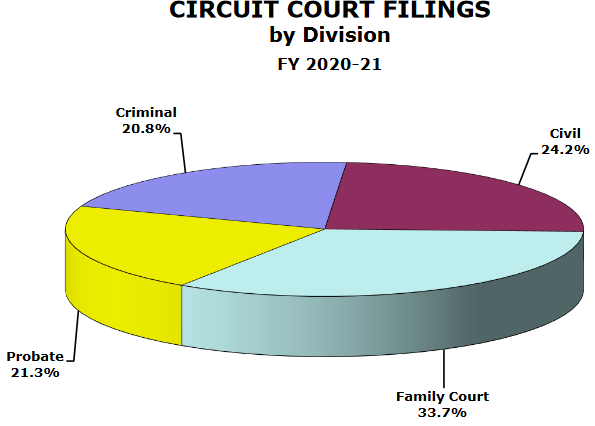
A little over 1 out of every 5 circuit court filings in Florida happen in one of our probate divisions (21.3%). That’s a lot of work for probate lawyers. Perhaps not surprisingly, the Real Property, Probate and Trust Law Section is the largest section of The Florida Bar.

Source: FY 2020-21 Statistical Reference Guide 2-5

By the way, it may come as a surprise to learn that only about half (49.8%) of the workload of your average probate court is dedicated to “probate” proceedings. And in some circuits it’s less than half. For example, in Broward the number of Baker Act filings (5,772) exceeded the number of probate filings (4,699). And here’s another somewhat surprising finding: “guardianship” and “trust” matters — which loom large in most practitioner conferences and publications — are a tiny sliver of the cases actually filed.

Source: FY 2020-21 Probate Court Statistical Reference Guide 6-3

How busy are our probate judges?

This chart is my creation. The goal is to get a sense of how busy our probate judges are by taking the “cases filed” data reported in the FY 2020-21 Probate Court Statistical Reference Guide 6-4 for three of Florida’s largest circuits/counties — (Miami-Dade (11th Cir), Broward (17th Cir), and Palm Beach (15th Cir) — and dividing those figures by the total number of dedicated probate judges for each of these circuits as reported in the FY 2020-21 Overall Statistics 2-2 page.

Type of CaseMiami-Dade (11th Cir)Broward (17th Cir)Palm Beach (15th Cir)
Probate5,123 4,699 5,368
Baker Act4,634  5,772 2,744
Substance Abuse768 828 686
Other Social Cases2,173365 255
Guardianship907 523 580
Trusts47 77 155
Total FY 2020-2113,652 12,264 9,788
Probate Judges
FY 2020-21
3.93.03.0
Total/Judge3,5014,0883,263 

What’s it all mean?

In Miami-Dade – on average – each probate judge took on 3,501 new cases in FY 2020-21, while in Broward the average was significantly higher at 4,088/judge, and in Palm Beach it was the lowest at 3,263/judge. Keep in mind these figures don’t take into account each probate judge’s existing case load or other administrative duties.

These caseload figures may be appropriate for uncontested proceedings, but when it comes to that small % of contested estate matters that are litigated these numbers (confirmed by personal experience) make two points glaringly clear to me.

First: “privatize” the dispute-resolution process whenever possible:

We aren’t doing our jobs as planners if we don’t anticipate — and plan accordingly for — the structural limitations inherent to an overworked and underfunded public court system. One important aspect of that kind of planning should be opting out of the public dispute-resolution system (our courts) and into a private dispute-resolution mechanism (arbitration) whenever possible. And how do you do that? Include mandatory arbitration clauses in all of your wills and trusts. These clauses are enforceable by statute in Florida. I’m a big fan of this approach (see here, here, here, here).

Here’s how the authors of the ACTEC Arbitration Task Force Report described the “structural limitations” argument for privatizing estate disputes:

What is now a choice to agree to arbitrate or to require arbitration may become a practical necessity. To have this vision one need only look to one’s own jurisdiction and the yearly budget disputes between governors and legislatures as they make difficult spending choices. The “third branch of government” is not an uncommon target. Within that debate, social and political considerations mandate that our leaders use their limited resources to fund criminal, juvenile, and family justice long before they reach estates and trusts. As judicial resources dwindle or shift to a more pressing use, it is apodictic that already slothful judicial resolutions of trust and estate litigation will slow even further. In jurisdictions with competent, up to date jurists, we see constant outsourcing of trials to retired judges and magistrates with more time on their hands. And, of course, the competent, up to date jurist will eventually retire.

Second: help our judges do the good job they want to do:

We aren’t doing our jobs as litigators if we don’t anticipate — and plan accordingly for — the “cold judge” factor; which needs to be weighed heavily every time you ask a court system designed to handle uncontested proceedings on a mass-production basis to adjudicate a complex dispute or basically rule on any technically demanding issue that can’t be disposed of in the few minutes allotted to the average court hearing.

And how do you do plan for the “cold judge” factor? Read Persuading a Cold Judge. Here’s an excerpt:

Begin at the beginning. In every court appearance, there are six basic queries to answer for a judge:

  1. Who are you?
  2. Who is with you, and whom are you representing?
  3. What is the controversy, in one sentence?
  4. Why are you here today?
  5. What outcome or relief do you want?
  6. Why should you get it?

This last query is most often forgotten. Indeed, these six essential queries are a good beginning even when you are dealing with a warm judge. Consider putting them on a PowerPoint slide, a handout in the form of an “executive summary,” or a demonstrative exhibit to project through Elmo or other presentation technology.

A judge in a suburban district told me that the one thing I could do to assist his judging was to begin succinctly by telling him what was before the court, remind him of the nature of the case, and tell him what action I wanted the court to take and why I thought I had the right to that action. Once I did this for him, he would be ready to listen to my argument. This particular judge told me that he has so many cases that he can’t read the motions before the hearing, and if he has read them, it was so long ago that he couldn’t recall what he’d read. He has no legal assistant to write memos for him; he does his own legal research, and if you cited more than 10 cases for him to read, he couldn’t do it. He likes being a judge and wants to do the best job he can, but he is forced to come into hearings and trials cold. So, help him be the good judge he wants to be and the quality of his decisions will be your reward.


Listen to this post

There have been numerous books and essays written about Mark Twain’s final two unhappy years in Redding, Connecticut, as well as several accounts capturing the lives, also generally tragic, of his surviving daughter and granddaughter.

A fascinating article co-authored by Connecticut judge Henry S. Cohn and attorney Adam J. Tarr entitled A Challenging Inheritance: The Fate of Mark Twain’s Will, retells some of that story, but from a legal perspective probate attorneys should find particularly interesting. The article makes use of source documents from the estates of Mark Twain and his descendants, including original wills, probate papers, trust instruments, and court and business filings.

By the way, another source with direct links to Mark Twain’s will and probate file (with annotated commentary) is an excellent 2010 NYT’s article entitled Twain’s Heavily Lawyered Last Words that’s well worth diving into.

Over a century after his death, Mark Twain still matters. On that note, A Challenging Inheritance: The Fate of Mark Twain’s Will concludes by explaining how the literary “Mark Twain” has succeeded in the twenty-first century, well beyond his death in 1910. Good stuff, highly recommended. Here’s an excerpt:

The last years of Mark Twain’s life were marked with tragedy and emotional hurt. He lost his favorite daughter in 1896, his wife in 1904, and his youngest daughter Jean on Christmas Eve 1909, just four months before his death. Mark Twain’s will, which was written in August 1909 just before his health worsened, captures this emotional state of affairs.

Even though the provisions of Twain’s will and Clara’s subsequent bequests were illustrative of familial grief, Mark Twain’s investments and accumulated assets were a positive factor and only grew over time. While even in death some of his investments were deemed worthless, the trustees under Twain’s will and the Mark Twain Foundation achieved many financial triumphs. Further, thanks to the Papers Project, the Mark Twain literary “brand” has been glowingly successful. Writing in the April 17, 1960 Hartford Courant, Bissell Brooke declared: “Mark Twain again has caught the public’s fancy. Posthumously, he has never been more ‘alive.'”